Union Hails UA Now Offering 2nd Chances

Petrino Rehiring Furthers ‘Employer of Choice’ Goal

The Executive Board of UA-Fayetteville Education Association/Local 965 welcomes the return of Coach Bobby Petrino because it demonstrates the possibility of a fresh flexibility in campus and UA System administrators.

Petrino was head football coach from 2008 until his April 2012 firing for cause, with offenses including deception of superiors and improper hiring practices. At the end of November 2023, he accepted a lower position, that of Razorback offensive coordinator, in a 27-month contract paying $3.45 million in salary and “other compensation.”

Under the UA System policy 405.6, “Termination of Employment and Eligibility for Rehire,” any eligibility for rehire comes from the statement, “Any exception to this policy will require the approval of the President.”

UA System President Donald R. Bobbitt approved the return of Petrino to the Fayetteville campus on Nov. 28. The Arkansas Democrat-Gazette reported Nov. 30 in “Coach’s Hire Took Bobbitt’s Approval” (and alternate link): “Writing on behalf of football Coach Sam Pittman and Athletic Director Hunter Yurachek, UA Chancellor Charles Robinson requested the exception to be made in an email to Bobbitt [Nov. 27].”

Petrino’s return would seem unfair because it’s a different standard than what staff and faculty face, Local 965 President Hershel Hartford said.

“Any former employee fired for cause who falls under the ban would not receive the chance to address the UA System president because the Workday employee management database would automatically kick out their application with no notice as to why it was not accepted, before ever having a chance to get through the system red tape. As many of these employees did not commit prosecutable offenses, this is a discriminatory employment practice,” Hartford said.

Local 965, the labor union of UA staff and faculty, see this as an opportunity for better and more fair treatment of all employees, and not just in matters of workplace discipline, as the leadership of the Fayetteville campus and UA System continue to work toward elimination of any sort of discrimination, not to mention of favoritism toward the athletic agenda.

Petrino is eligible for union membership.
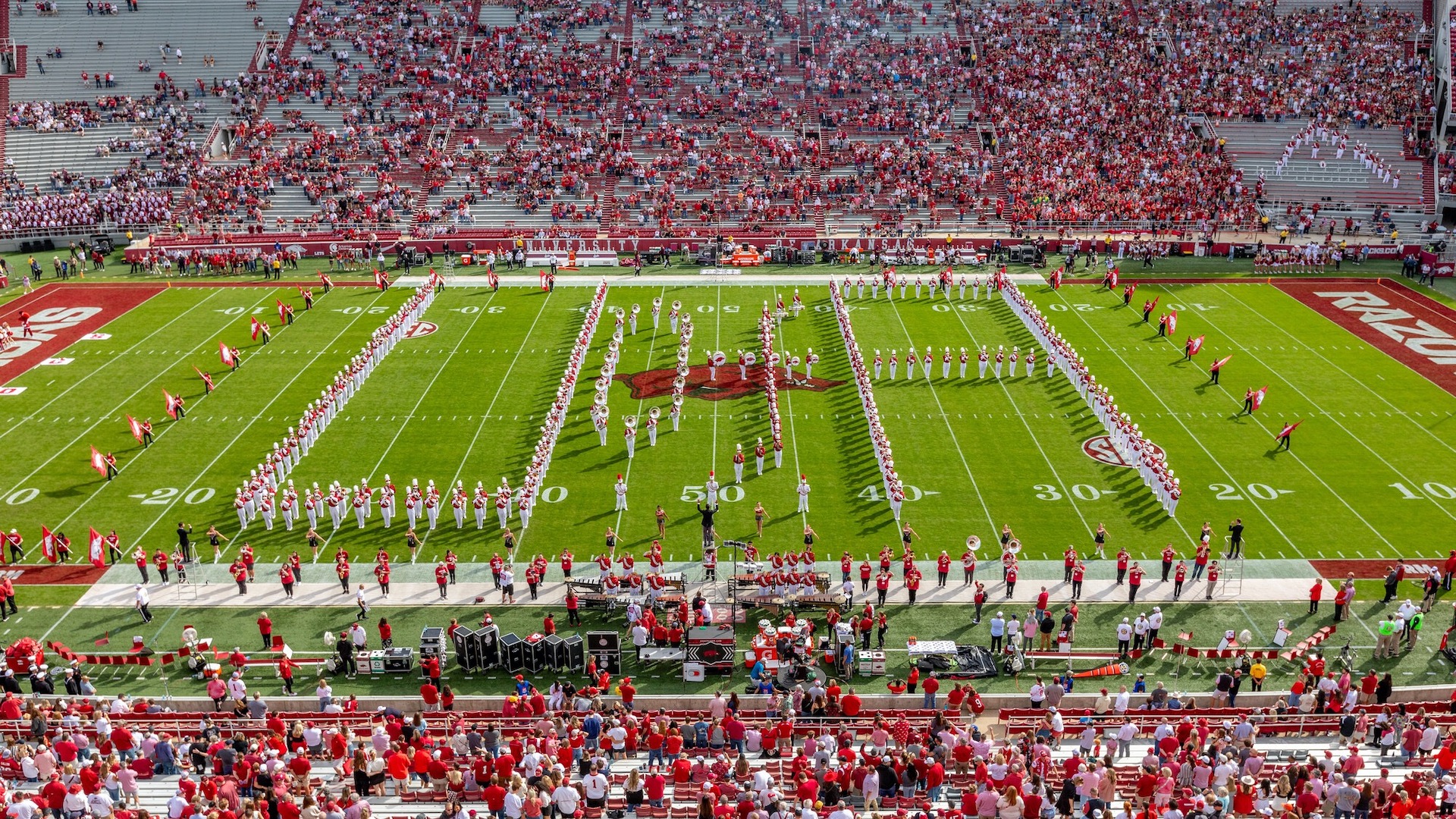
Band on field, Homecoming 2023, Arkansas vs. Mississippi State
Homecoming 2023, Arkansas vs. Mississippi State. Credit U of A University Relations

What ‘Employer of Choice’ Should Be

We have been hearing the phrase “Employer of Choice.” It refers to one of the pillars of the chancellor’s vision for the University of Arkansas. He has mentioned it in almost every speech. Yet we still have people asking, what is an employer of choice?

President’s Message

By Hershel R. Hartford

Over the past year we have heard the phrase “Employer of Choice” on campus. It refers to one of the pillars of Chancellor Charles F. Robinson’s vision for the University of Arkansas. He has mentioned it in almost every speech he has given and every visit he has made with various groups on campus. Yet we still have people asking, what is an employer of choice?

I have heard what the chancellor has said and agree with many of his ideas. I am hoping, waiting and watching to see if this effort will bring about a change that may hearken back to another day and time, some 22 years ago, when quality prospective job candidates seeking employment were told, “Go to the University of Arkansas. It is the place to work!” That is a phrase not heard in a very long time. Perhaps we need this help-wanted ad for an Employer of Choice:


Wanted: An EMPLOYER OF CHOICE, which provides a workplace that respects every employee regardless of their occupation and treats them with the dignity and respect they deserve.

Required conditions include:

Fair, equitable and livable wages for all employees that provide:

  • All workers with the ability to have quality housing in the community where they work
  • Wages that will not require them to make use of food banks to make it through the month
  • Engagement by Upper Administration with supervisors to end a culture that denies or attempts to quell any raising of ideas or concerns that are contrary to “the way things have always been,” or demands work from international graduate students holding visa status over their heads
  • A restructuring of compensation for instructors, adjuncts and graduate assistants that reflects the workload they shoulder
  • Healthcare benefits that meet the needs of employees (including graduate assistants) without breaking their budgets with unreasonable policy exclusions or sky-high premiums
  • A commitment to support — by example and by codification in personnel document and university policy — a work/life balance that requires supervisors and departments to respect and guard employees’ time away from work, be that hours before and after a workday, vacation, sick time or university holidays
  • A true sense of Community that comes from a culture that promotes Respect, Diversity, Equity and Inclusion
  • The opportunity to retain representation that can be present in all grievance/ disciplinary processes
  • Safe working conditions, always including compliance with OSHA safety standards
  • Continued upgrades to facilities to be more accessible to all persons with ADA accommodation needs
  • Parking, which does not draw wages back to the University that the worker has earned
  • The clear communication that while we live in a right to fire state, employee organizing is not prohibited nor is it a reason for firing

Preferred conditions include:

  • Transparent communication at all levels of administration
  • Increased hiring of support staff to match the growth rate the institution has achieved over the past number of years on a trajectory similar to the increases in upper administration areas. Growth would include office workers, custodial, labor shop and maintenance workers
  • Greater compensatory recognition for employees instead of speeches wishing you could do more, and telling staff how we could not do this without you
  • A return of reduced rates for opportunities to engage in the university cultural, sporting and other events.

This President’s Message first appeared in the November 2023 newsletter of UA-Fayetteville Education Association / Local 965. Hershel Hartford, a UA administrative support supervisor, is president of Local 965.

Enthusiasm at 1st NWA Labor Spring Teach-In

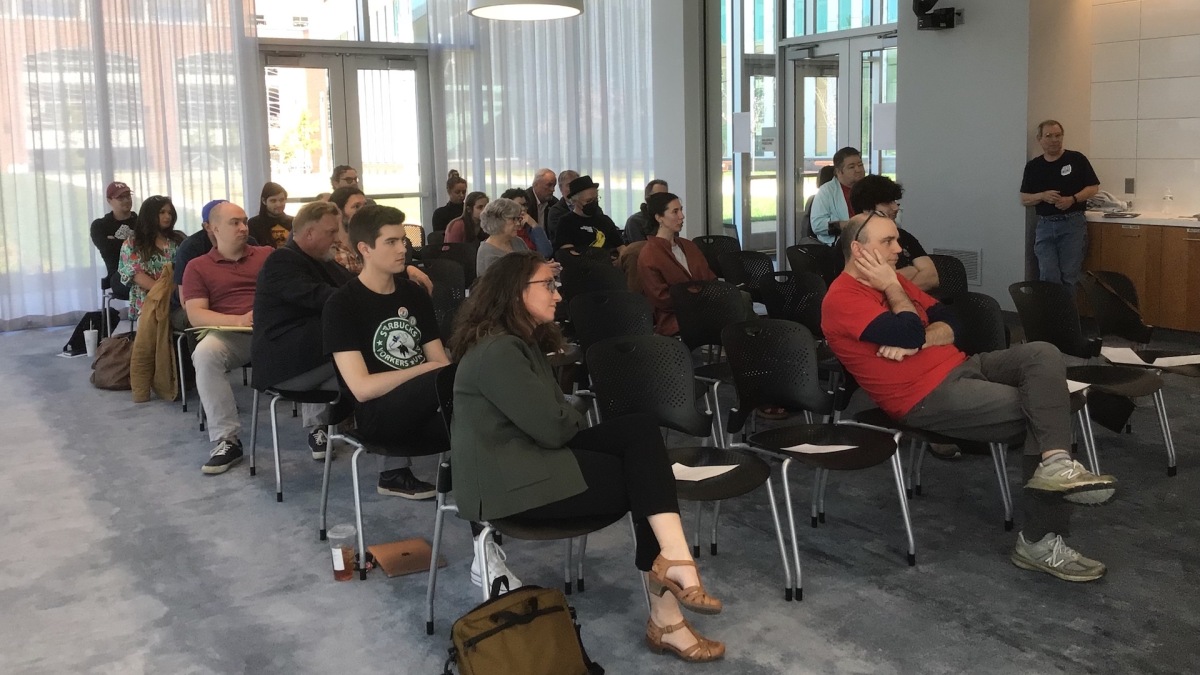
A few dozen workers of all ages listened to eight regional union organizers at the Northwest Arkansas Labor Spring Teach-In April 8, gaining knowledge and enthusiasm from their fellows.

The program in the Ziegler Reception Room of the Fayetteville Public Library began with perhaps the newest labor movement, that of Starbucks Coffee employees. Dylan Hartsfield began organizing employees of the cafe on Wedington Drive in February 2022. Since its success and that of a Starbucks on Martin Luther King Jr. Boulevard, Dylan has become an organizer with the overall Starbucks Workers United, a division of the Service Employees International Union (SEIU).

Walter Hinojosa, president of the Northwest Arkansas Labor Council, emceed while Hershel Hartford, president of UA-Fayetteville Education Association / Local 965, introduced the program. These two groups sponsored the teach-in.

Magaly Licolli, executive director and co-founder of the regional poultry worker organization Venceremos said her group is chiefly concerned with a “search for solutions” on worker safety matters. As far as chicken growing and processing, any sort of safety net set up by government is full of tangles and tears, where she cited chemical emissions and denial especially of the dangers of Covid especially in the pandemic’s early months.

Annie B. Smith, professor, University of Arkansas School of Law, outlined the basics of federal law on unions as well as the limits state laws sets, both positive and negative. Worker’s compensation law, for example covers an employee injured due to their own miscalculation, but “Workers generally do not have a right to breaks” (they’re just a common perk).

Pete Reagan, district field service representative for the 14th District (Arkansas, Louisiana, Mississippi, Alabama and Tennessee), International Association of Fire Fighters , gave a brief history of the Fayetteville local that began in the late 1970s. Its latest concern is the incorporation of PFAs (per- and polyfluoroalkyl substances in their gear to repel oil and water and prevent mold but is a carcinogen. “Our own gear is killing us.” 

Rick Halford, regional political director of Southern States Millwright Regional Council  discussed the close relationship between child labor and human trafficking in light of the Arkansas legislature with Gov. Sarah Huckabee Sanders’ signature revoked state law pertaining to children working, though federal laws remain in effect.

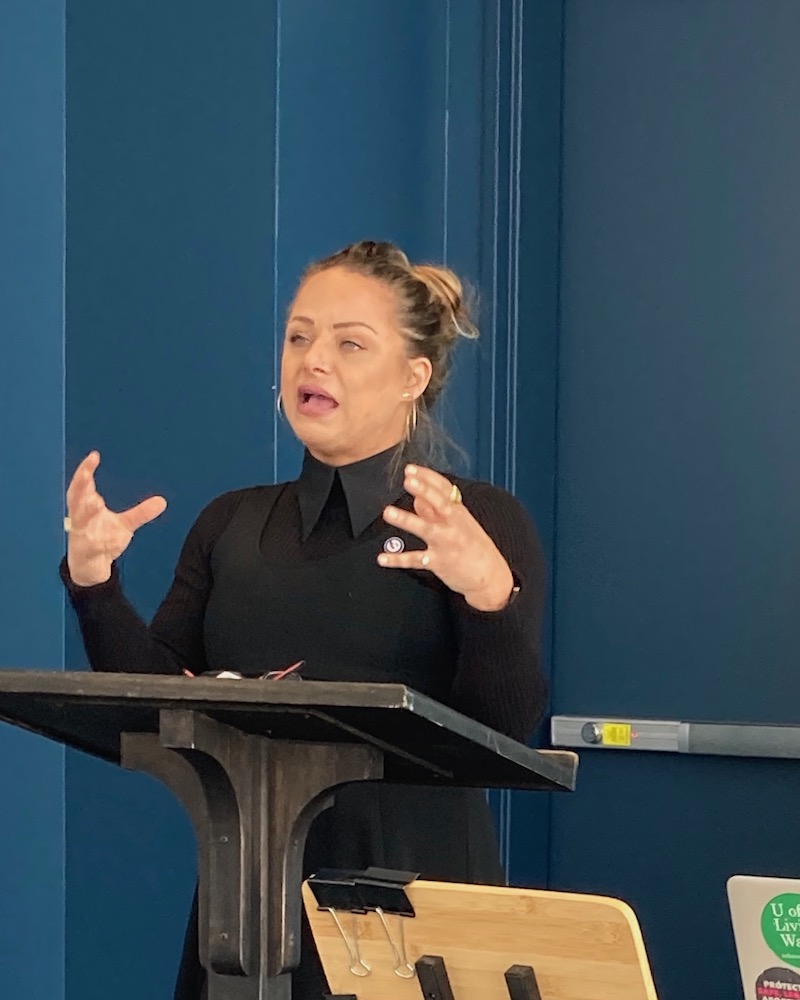
Closing out the program was Jessica Akers Hughes, president, Arkansas AFL-CIO. She sees the governments of a number of states trying to divide workers, a common tactic that in recent years uses gender, sexuality, race. “If we didn’t have power, they wouldn’t be trying to silence us,” she said.

The inaugural Northwest Arkansas Labor Spring Teach-In was held April 8, 2023, at the Fayetteville Public Library.

UA Repped at NEA Higher Ed Conference

In what seems to have been the first time, at least officially, the University of Arkansas was represented at the annual Higher Education Conference of the National Education Association. UA-Fayetteville Education Association / Local 965 is the first NEA higher ed chapter in the state.

NEA President Becky Pringle in her welcome said a major goal is to re-establish public education, including public higher education, as a common good for the country, adding “We are the ancestors of future generations.”

Local 965 President Hershel Hartford and Vice President Ben Pollock traveled to San Jose, California, for the March 17-19 meeting. Because the two represented the state, the Arkansas Education Association picked up their air fare and the NEA their hotel. No money from the Local treasury was needed.

Here are some highlights:

Two leaders of the Michigan State University chapter noted their strategy is to continually focus on both recruiting and retaining union members. Their meetings are best attended when on Zoom and when held during a weekday lunch hour, as “it’s hard to get people to attend in person or online after work.” They also give away lots of logo souvenirs, noting that desktop items, often with their slogan “Stronger Together,” seem to be most effective.

NEA Senior Digital Strategist Justin Conley had dozens of tips. Use social media to “take an action” or “share a message,” noting that “authenticity is the secret sauce.”

Still images and videos remain important in sharing the message or telling a story, the “TikTok-ization” of digital messaging, he said. But videos shouldn’t be longer than a minute. Always set the automatic closed-captioning on videos as people often don’t have their volume up.

Most of Justin’s knowledge comes from his observing how the apps’ algorithms seem to work. Be mindful those change periodically, he said. Algorithms are to help us, help the companies make money but also to thwart competitors (using hashtags on Facebook tells it you probably copied over a Twitter tweet so that pushes the post down). YouTube has come to function as a social media outlet so it should be used as that in sharing information.

Doug Hurst of St. Louis Community College teaches communications skills there. His previous career as a criminal defense lawyer gave his hour a unique spin. As a union leader, Doug reminded us: “We are always organizing.” He noted with examples and exercises how unreliable perceptions and memories are, and that “communicators can influence but not control perceptions of others.”

Gary Rhoades, a professor of higher education at the University of Arizona as well as a union leader there, discussed strategies for collective action. The main strategy against us is “divide and conquer” using categories of employees to separate from our goals faculty from support professions from graduate student employees. Gary recommends forming alliances with students and campus media as well as the region’s political leaders and other unions. 

The closing speaker Sunday morning was U.S. Rep. Katie Porter, D-California. She’s a former professor and known in recent years for piercing, well-prepared questions at hearings. Porter noted, “Nothing prepares you (in teaching and lecturing experiences) for dealing with a corporate blowhard or incompetent government official in Congress.” Yet she noted to us, “Every voice matters” no matter how soft and that “education is a public good that should be publicly funded.”

Graphic for the 2023 NEA Higher Ed Conference

Spring Teach-In at Library April 8 to Focus on NWA Labor Issues

Anyone with a job can relate to widespread problems that continue here in Northwest Arkansas as well: Economic inequality, low wages, persistence of poverty especially among children, and the growing marginalization of working people in public life.

An afternoon of programming to address such issues is being set up for the Ozarks.

Logo for the Northwest Arkansas Labor Council

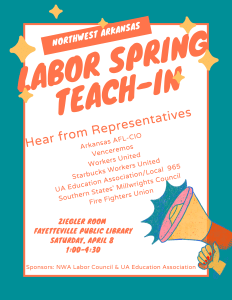
The Northwest Arkansas Labor Council and UA-Fayetteville Education Association/Local 965 are hosting the Northwest Arkansas Labor Spring Teach-In at the Fayetteville Public Library’s Ziegler Reception Room from 1-4:30 p.m. Saturday, April 8, 2023. It is free, and the public is welcome.

The Labor Teach-In will highlight the ways that unions and collective action on the part of working people can contribute to the elimination of these pressing problems.

Speakers will include representatives from the Arkansas AFL-CIO, Starbucks Workers United, Venceremos for poultry workers, UA’s Local 965, Southern States Millwright Regional Council and the International Association of Fire Fighters. Here are confirmed presenters.

Poster for 2023 NWA Labor Spring Teach-In
Download PDF poster

The teach-in is an informal forum developed in the mid-1960s to educate on a complex contemporary topic.

“The Teach-In is inspired not only by the activism that we are seeing throughout the nation with teachers, nurses and Amazon workers but also by what people are already doing here in Northwest Arkansas,” co-organizer Michael Pierce said. “Starbucks workers, some of the poultry workers, and many others are starting to stand up for worker rights, better wages and improved conditions.”

“The goal,” Pierce said, “is to bring together working people who want to make their jobs better — to put them in touch with like-minded people, to provide them with tools and access to resources, to hear about successes, and to provide a sense of belonging.”

The Northwest Arkansas Labor Spring Teach-In is part of a series of some 60 similar events being held on or near college and university campuses throughout the United States. Dubbed Labor Spring, these events are organized with the help of the Kalmanovitz Initiative for Labor and the Working Poor at Georgetown University and the Labor and Working-Class History Association.

The February 2023 article “In 1996, There Was Union Summer. This Year, There’s ‘Labor Spring’ — ‘Labor Spring’ Brings Back a National Teach-In on Organizing to Campuses across the Country” further explains the project.

Updates on the Teach-In will be posted on its Facebook event page. For more information, write us.

Presenters

In alphabetical order, as schedule has not been finalized.