Time for Organizing Is Now

President’s Message

By Hershel R. Hartford, president
UA-Fayetteville Education Association / Local 965, AEA/NEA

As we journey through another academic year, it’s essential to recognize a fundamental truth: The time for organizing is always now. In our rapidly changing educational landscape, where challenges and opportunities present themselves daily, our collective strength as a union is paramount.

Membership and participation in our Local 965, as well as at the state and national levels, are not merely beneficial; they are crucial. Together, we form a powerful coalition that advocates for the needs of our educators and the diverse communities we serve. Here’s why your involvement is vital:

Local Impact

At the local level, our organizing efforts translate directly into improvements in our workplace. By participating in the UA-Fayetteville Education Association, you can help shape policies that affect class sizes, working conditions, wages and our students’ educational experiences. Each voice adds to the collective call for equity and excellence in our schools. Your engagement in meetings, committees and community events makes a significant difference in how effectively we can advocate for ourselves and our students.

Statewide Solidarity

As part of the Arkansas Education Association, we possess the capacity to influence statewide educational policies and funding decisions. Our voices, united, can pave the way for legislative changes that benefit all educators and students. Advocacy at this level ensures that our concerns reach policymakers who hold the keys to better funding, fair pay and comprehensive resources for our classrooms. Your participation in state rallies, lobbying efforts and educational forums can amplify our message and significantly impact our profession across Arkansas.

National Visions

On a national scale, the challenges we face—such as teacher shortages, education funding and workplace rights—are intertwined with broader policies and political climates. Organizations like the National Education Association work to represent our interests on legislative issues across the country. When we stand together, we not only amplify our local and state concerns but also contribute to a larger movement advocating for quality education for all. It’s essential that every member participates in campaigns, advocacy days and national conferences, ensuring our voices resonate beyond our local communities.

Every Voice Matters

In conclusion, organizing is not a task to be undertaken solely during times of crisis. It is an ongoing commitment that requires each of us to engage actively. Whether attending meetings, joining committees, participating in advocacy efforts, or simply sharing your experiences, your involvement is vital.

Remember, when we act together, we can achieve lasting change. Let’s embrace this moment to strengthen our union and, in turn, our profession. Together, we can ensure that our voices are heard, our rights are protected and our educational system thrives.


This column was first published in the Local 965 monthly newsletter March 24, 2025.

Embracing Peaceful Resistance

A Call to Action from Hershel Hartford, President of UA-Fayetteville Education Association / Local 965

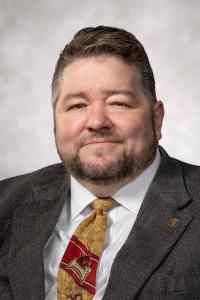
Hershel Hartford
Hershel Hartford

As the president of the UA-Fayetteville Education Association / Local 965, I write to you with a sense of urgency and determination. The landscape of our nation is ever-changing, influenced heavily by the policies and decisions made at both the state and federal levels. As educators, advocates and citizens, we find ourselves at a crossroads where our voices matter more than ever. It is essential that we channel our concerns about current actions detrimental to our communities into peaceful personal resistance.

Peaceful resistance is a nonviolent approach to express dissent, advocate for change and stand in solidarity with those who are marginalized. It is rooted in the belief that change can emerge from a foundation of respect, collaboration and understanding — values that resonate deeply within the educational community. We must find ways to assert our right to voice our beliefs while fostering an environment that promotes dialogue and respect.

1. Educate Yourself and Others

Knowledge is a powerful tool for change. To effectively resist, we must understand the policies and actions impacting our communities. Stay informed about federal and state legislation, and engage with credible sources that provide varying perspectives. Share this knowledge with colleagues, students and families. By hosting discussions or workshops, we can create a well-informed community capable of navigating the complexities of current issues.

2. Engage in Community Dialogue

Encouraging open conversations within our communities can foster understanding and solidarity. Arrange forums or community meetings that allow individuals to share their experiences, opinions and knowledge. By listening to diverse viewpoints, we can cultivate empathy and build a unified front in advocating for positive change. Your voice, when combined with others, creates a powerful collective.

3. Advocacy through Representation

Engage with local, state and federal representatives. Write letters, make phone calls or attend town halls to articulate your concerns and advocate for policies that align with our values. Consider forming a coalition with other local organizations to strengthen our impact. When representatives hear from a united, informed constituency, they are more likely to listen and act.

4. Use Social Media Responsibly

In our digital age, social media can be an effective platform for raising awareness and mobilizing support. Share informative content, promote community events and amplify the voices of those impacted by unjust policies. However, be mindful to engage in civil discourse. Our online interactions should seek to educate rather than antagonize, fostering a respectful exchange of ideas.

5. Support Local Initiatives

Support local organizations and movements that align with your values. Participate in peaceful protests, volunteer for causes that matter to you or donate to organizations that work toward social justice, education equity and community support. Your involvement can help amplify the efforts of those working tirelessly for a better future.

6. Model Resilience and Compassion in Education

As educators, we have a unique role to play in inspiring resilience and compassion in our students. Encourage critical thinking, empathy and civic involvement within your classrooms. By equipping our students with the tools to understand their rights and responsibilities as citizens, we empower the next generation of leaders who will champion positive change.

In these challenging times, it is crucial that we respond with peaceful, personal resistance. Together, as a united front within the UA-Fayetteville Education Association / Local 965, we can inspire change through education, advocacy and community engagement. Let us commit to nurturing an environment where every voice matters and every action counts. In our pursuit of justice and equality, may we find strength in our solidarity, compassion in our resistance and hope in our collective action.


This column was first published as the President’s Message in the February 2025 newsletter of UA-Fayetteville Education Association / Local 965.

Third Annual Labor Spring Teach-In Set for March 8

By Walter Hinojosa, President
Northwest Arkansas Labor Council, AFL-CIO

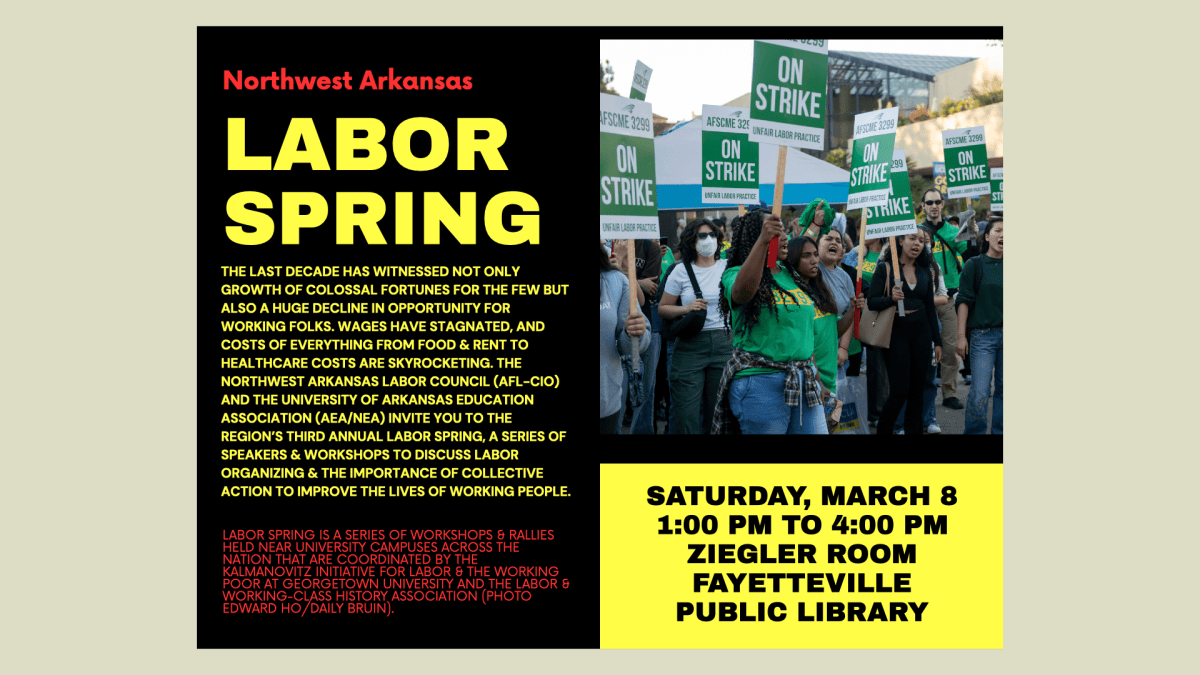
Poster for the 3rd annual UA Labor Spring Teach-in, 1-4 p.m. March 8, 2025, at the Fayetteville Public Library
Click image to download poster

Under the theme “Addressing Labor’s Troubling Times,” the Northwest Arkansas Labor Council, in collaboration with the 965 Local of the Arkansas Education Association, will hold its third annual Labor Spring Teach-In on Saturday, March 8, 2025. The event will be held from 1 to 4 p.m. in the Ziegler Reception Room of the Fayetteville Public Library.

The program is free, and the public is welcome. The schedule below is subject to change.

1-1:10 p.m.Walter Hinojosa, NWA Labor Council president, as emcee will introduce the program.
1:10-1:30Ike Mills, president of Local 667 of the American Postal Workers Union. He will speak about the future of postal workers.
1:30-1:45Joey Cornelius, general chairman of the SMART-Transportation Div-GCA 569. He will speak on how the Trump agenda will impact our railroad workers.
1:45-2:15Diana Hicks, international vice president for Region 9 of the American Federation of Government Employees. She will speak on the efforts her union is taking to protect federal employees and their jobs. Local 2201 represents area members.
2:15-2:30The Rev. Clint Schnekloth, pastor at Good Shepherd Lutheran Church in Fayetteville. The reverend will also speak on the impact of the Trump agenda is having on the migrant community.
2:30-2:45Break
2:45-3Irvin Camacho is a Latino activist based in Northwest Arkansas. He is the creator/host of the District 3 Podcast.
3-3:45Andrea Provins, a Rogers immigration lawyer. She will also speak about the current migrant situation.
3:45-4Wrap-up led by Michael Pierce, U of A associate professor of history specializing in labor and race.
#LaborSpring 2024 official rose logo

Labor Spring events are held nationwide, a concept coordinated by the Kalmanovitz Initiative for Labor and the Working Poor of Georgetown University and the Labor & Working-Class History Association.

The purpose, states the initiative, is to bring “together students, workers, unionists, allies, environmentalists, elected leaders and more to support workers’ organizing efforts in a broad range of events, anchored on college campuses and in the community. Each unique event is organized by local committees, crossing institutional silos and ideological divides, and uniting workers and campuses to bolster workplace justice, racial equity, and the public good.”

teach-in is an informal forum developed in the mid-1960s to educate on a complex contemporary topic.

For more information, contact uarkansas965@gmail.com. Any event changes will be posted here as updates.

Local 965 Honors M.L. King

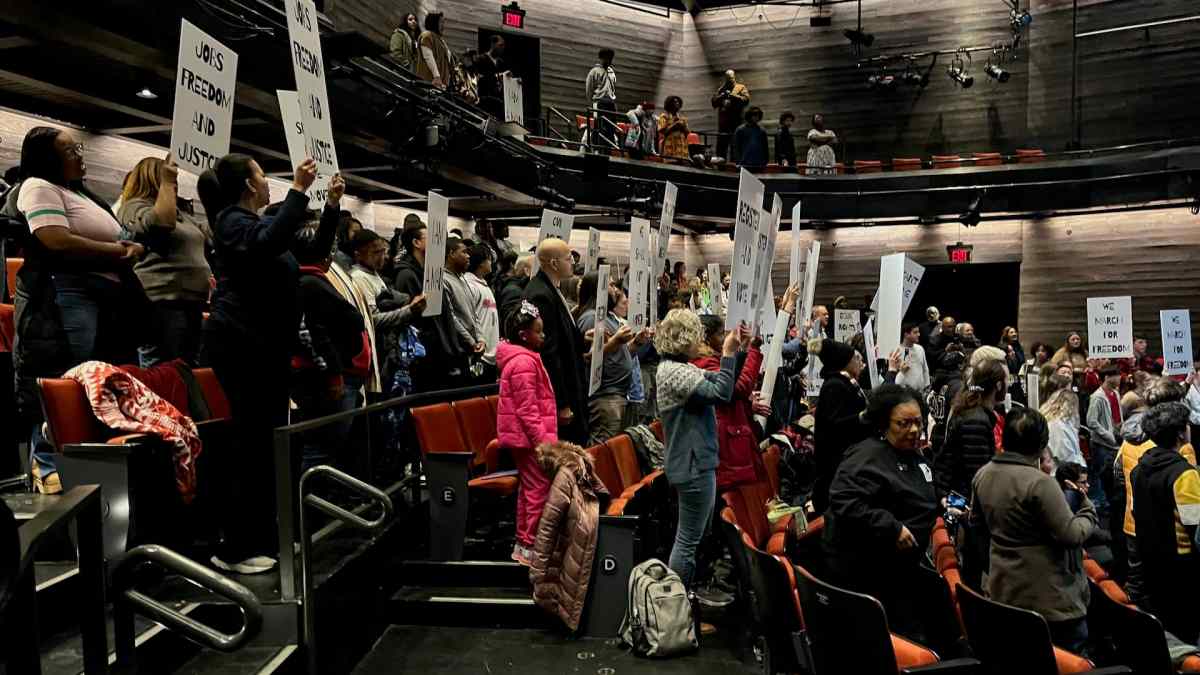
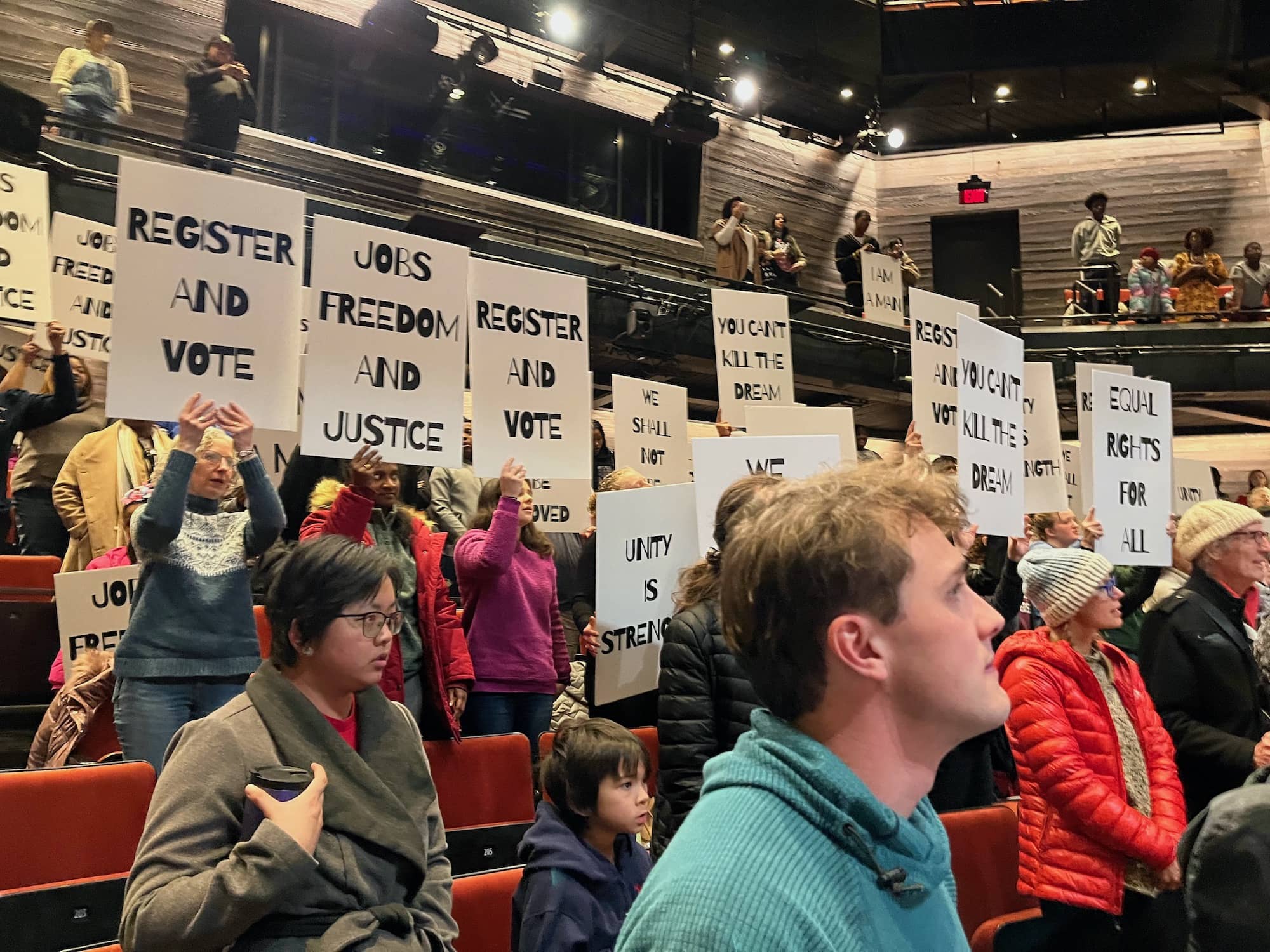
UA-Fayetteville Education Association / Local 965 was represented at the 29th annual Freedom March of the Northwest Arkansas MLK Council. With temperatures in the low 20s, the march was retrofitted into an auditorium sit-down program on the national Martin Luther King Jr. holiday Monday, Jan. 20, 2025.

Union members were among the estimated 200-plus audience members to hear a couple of traditional songs, an invocation and a reading of King’s final speech “I’ve Been to the Mountaintop” by four men and a woman.

For Local 965, a key moment was that the audience held its ovation after the speech reading ended. With no prompting the crowd stayed silent for a long moment, in reflection, until the emcee encouraged applause.

Members of Local 965 were among a couple hundred observing the indoor Freedom March Monday, Jan. 20, 2025, at Fayetteville's Theatre Squared.
Members of Local 965 were among a couple hundred adults and students observing the indoor Freedom March Monday, Jan. 20, 2025, at Fayetteville’s Theatre Squared.

Media reports fill in some key details:

The Northwest Arkansas MLK Council hosted several events over the holiday weekend including an address in conversation format by best-selling author and Vanderbilt sociology professor Michael Eric Dyson at its 29th annual Recommitment Celebration Program on Jan. 18 at Fayetteville Public Library.

Log of Our Delegate to the DNC

Hershel Hartford, president of UA-Fayetteville Education Association / Local 965, was elected a delegate to the 2024 Democratic National Convention by the Arkansas Democratic Party. As he posts these reflections, this log will be updated.

Tuesday afternoon, Aug. 20

Local 965 President Hershel Hartford awaits the first night of speeches at the 2024 Democratic National Convention in Chicago, sitting with the Democratic Party of Arkansas delegation.

After a great welcome at the Navy Pier by the city of Chicago, I was reminded about community, specifically the quote by Rabbi Joachim Prinz that I reposted the other day: “Neighbor is not a geographical term, it is a moral concept.” I have spent two days talking, sharing and observing a myriad of people from across this country.

Sunday night when I was in line to catch the shuttle back to our hotels, I was party to conversation between an entrepreneur from Pennsylvania, a union organizer from California, a farmer from Iowa, a college student from Arizona and a retiree from Mississippi. We were strangers from different places, backgrounds, incomes, races, genders and economic circumstances. We bring different challenges in our lives, and yet we spent an hour or so together.

Local 965 President Hershel Hartford meets California Gov. Gavin Newsom at the 2024 Democratic National Convention in Chicago.

We talked about our lives, our families, our states and so much more. Along the way there were common bonds and policies and subjects on which differences of opinion were discovered. No one was forced to join in, we all chose to join this discussion. We talked and laughed and debated, sometimes vehemently, but when we parted ways that night we parted friends each having a little insight in to the lives of our new neighbors.

Conventions are like that — intentional communities that benefit from the input of person, none individually more important than the other, but each vastly important to the whole.


Noon Sunday, Aug. 18

Amtrak Eagle northbound to Chicago
Amtrak Eagle northbound to Chicago. Photo by Hershel Hartford

Currently aboard Amtrak’s Texas Eagle with service from San Antonio to Chicago. I boarded the train in St Louis on my journey to the Democratic National Convention. Many of my fellow passengers are headed there as well. I am excited to participate in this convention, to advocate, learn and share in part of the political process through which our countries leaders are chosen. As we waited in the station there was lively discussion regarding candidates, policies and even strategy.

Just in this short journey we see concrete jungles and wide open fields, cities, suburbs, farms and small towns just some of the variety of areas and people that make up our country. I am also aware as we are traveling how interconnected these various landscapes are, despite the differences and, while none of these areas are perfect and all of them have their challenges and issues, they are a mosaic that inspires in me hope.

The hope that we might recognize that it is when we come together and really look beyond ourselves, we can recognize the amazing possibilities when we work together.